AI Governance: Building Responsible AI Teams
As AI regulations evolve and stakeholder expectations for responsible AI deployment increase, organizations need specialized governance talent to navigate this complex landscape while maintaining innovation momentum.
The Governance Imperative
The rapid adoption of AI across enterprises has created an urgent need for robust governance frameworks. Recent regulatory developments, including the EU AI Act, emerging US federal guidelines, and industry-specific requirements, have made AI governance not just a best practice—but a business imperative.
Our analysis of 200+ enterprise AI implementations shows that organizations with dedicated AI governance teams experience 45% fewer compliance issues and 60% faster regulatory approval processes compared to those relying on ad-hoc governance approaches.
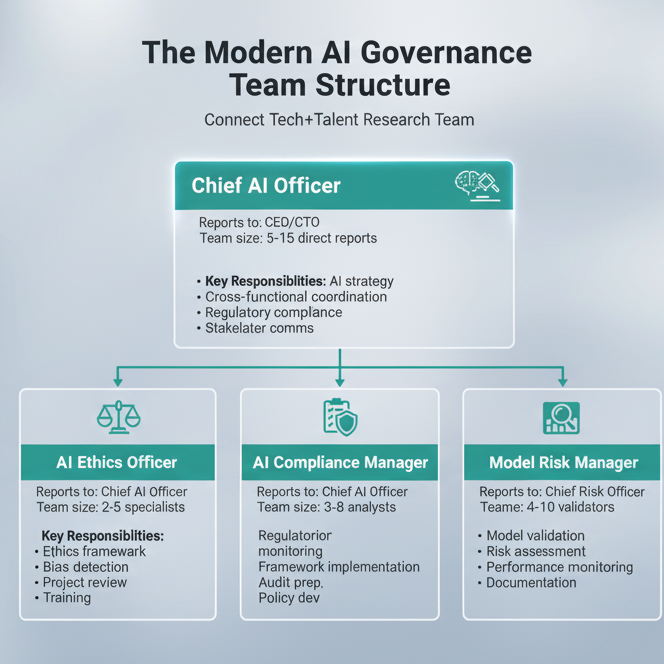
The Modern AI Governance Team Structure
Effective AI governance requires a multi-disciplinary team with clearly defined roles and responsibilities. The organizational chart above illustrates the optimal structure for enterprise AI governance teams.
Chief AI Officer
Executive oversight of AI strategy, governance, and risk management
Key Responsibilities:
- AI strategy development and execution
- Cross-functional AI governance coordination
- Regulatory compliance oversight
- Stakeholder communication and reporting
CEO/CTO
5-15 direct reports
AI Ethics Officer
Ensures ethical AI development and deployment practices
Key Responsibilities:
- AI ethics framework development
- Bias detection and mitigation strategies
- Ethical review of AI projects
- Training and awareness programs
Chief AI Officer
2-5 specialists
AI Compliance Manager
Manages regulatory compliance and audit requirements
Key Responsibilities:
- Regulatory landscape monitoring
- Compliance framework implementation
- Audit preparation and management
- Policy development and maintenance
Chief AI Officer
3-8 analysts
Model Risk Manager
Oversees AI model validation and risk assessment
Key Responsibilities:
- Model validation and testing
- Risk assessment and mitigation
- Performance monitoring
- Documentation and reporting
Chief Risk Officer
4-10 validators
Building Your Governance Framework
Successful AI governance isn't just about hiring the right people—it's about creating the right organizational structure and processes. Here's how leading enterprises are approaching this challenge:
Phase 1: Foundation (Months 1-3)
- • Establish Chief AI Officer role and governance charter
- • Define AI risk appetite and governance principles
- • Create cross-functional AI governance committee
- • Begin regulatory landscape assessment
Phase 2: Implementation (Months 4-9)
- • Hire AI Ethics Officer and Compliance Manager
- • Develop AI ethics framework and bias detection protocols
- • Implement model validation and approval processes
- • Create AI governance policies and procedures
Phase 3: Optimization (Months 10-12)
- • Add Model Risk Manager and specialized validators
- • Implement continuous monitoring and reporting systems
- • Conduct governance framework effectiveness review
- • Plan for regulatory compliance audits
The Compliance Connection
AI governance teams work closely with traditional compliance functions but require specialized expertise in AI-specific regulations and standards. This includes understanding frameworks like ISO/IEC 42001, NIST AI Risk Management Framework, and emerging regulatory requirements.
Organizations looking to build comprehensive AI compliance capabilities should explore our AI Risk & Compliance services to understand the full spectrum of specialized talent needed for responsible AI deployment.
Key Success Factors
Executive Support
AI governance requires strong executive sponsorship and clear authority to make binding decisions across the organization.
Cross-Functional Integration
Governance teams must work closely with legal, risk, IT, and business units to ensure comprehensive coverage.
Continuous Learning
The regulatory landscape is evolving rapidly; governance teams must stay current with emerging requirements and best practices.
Technology Integration
Modern governance requires sophisticated tools for monitoring, reporting, and managing AI systems at scale.
The Path Forward
Building an effective AI governance team is not a one-time project—it's an ongoing organizational capability that must evolve with your AI maturity and the regulatory landscape. The organizations that invest in governance early will have a significant advantage as AI regulations become more stringent and stakeholder expectations continue to rise.
The window for proactive governance is narrowing. Organizations that wait for regulatory enforcement or public incidents to drive governance initiatives will find themselves at a significant disadvantage in terms of both compliance costs and competitive positioning.
Related Resources
AI Compliance Services
Explore our comprehensive AI risk and compliance talent solutions.
Learn More →CIO Staffing Guide
Strategic insights for building comprehensive AI teams that include governance.
Read Guide →Ready to Build Your AI Governance Team?
Don't wait for regulatory enforcement to drive your governance strategy. Connect with our specialists to build a proactive AI governance framework that enables innovation while managing risk.
Start Building Your Governance Team